
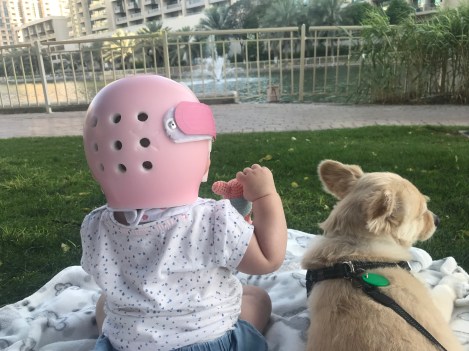
It has been a while since we posted simply because life has just continued on as normal. Emilia wears her head band every day and it is a part of our daily lives. She honestly does not notice when it is on or off. When it is off she loves looking at it, poking her fingers through the little holes at the back and waving it around. Her progress has been fantastic! Initially her head shape was classified as severe with a cephalic index of 99.9% which meant her head was wider than it was longer. It went down to moderate and has now just entered the mild category which is what we are aiming for. We have been for a few scans and you can see the progress quite clearly. Her head has only grown 1mm in width but it has had 10mm growth in length which is perfect as we want length growth over width growth.


I was worried that the head band may slow down her development in regards to crawling with the added weight on her head but it hasn’t! She is almost 8 months now and is SO SO ready to start crawling… we just need to get her crawling forwards as she is a machine at crawling and shuffling backwards!! lol.
You can see from the break down of the results and scan pictures inserted below that Emilia’s face and head shape is becoming more symmetrical. She still has mild plagiocephaly on the left side of her head (it is slightly flatter on one side more than the other) so we still have a few more weeks to go to encourage the left side (Q4 in the scan) to even out with the right side (Q3)
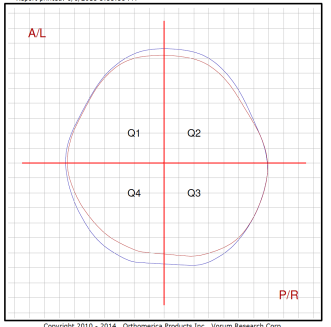
Here are her measurements and an explanation as to what each of the measurements mean because its all gibberish to me! The numbers in red are from her first scan and the numbers in blue are from her latest scan.
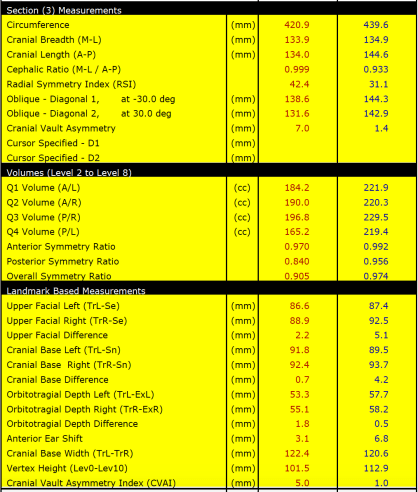
Cephalic Ratio =Cranial Breadth / Cranial Length. An ideal ratio would be anywhere between 78% and 85%.
- Radial Symmetry Index (RSI)= From the front of the head, 15° segments are measured and added. The addition of the right side segments is substracted to the addition of the left side segments. An ideal ratio would be left side – right side = 0
- Oblique at 30 deg (US1 and US2) = Length of diagonal taken at 30° on each side (30° corresponds to the corner of the eye). The substraction of US1 and US2 gives an indication of the assymetry of the head.
- Cranial Vault Asymmetry An assymetry bet. 0 and 10 mm is classified as mild, bet 10 and 16 mm medium and over 16mm severe.
- Q1, Q2, Q3, Q4 volumes: Draws vertical and horizontal lines centered on middle point of head. Measures volume of each corner starting front left, then front right, back right and back left.
- Anterior Symmetry Ratio: looks at front of head and divides front left volume with front right volume. An ideal ratio would be 1
- Posterior Symmetry Ratio: looks at back of head and divides back right volume with back left volume. An ideal ration would be 1
- Overall Symmetry Ratio: Divides left side with right side. An ideal ratio would be 1
- Upper facial left and upper facial right: Measures the length between the centre of the front to each left and right ear. This corresponds to a cranial bone and determines the position of the ear.
We have our next appointment in 3 weeks time and we are hoping it is the last appointment. Ideally we would like her Cephalic Ratio to be anywhere between 89% and 91% so our fingers are crossed that we get closer to those numbers. If we do, it is goodbye head band and hello head kisses!
 BrachyandChatty
It is looking good and well done Emilia on just getting on with life!
LikeLike
Fantastic news guys….ur on the home run!!xx
LikeLike
Yaaaaaay so happy to see such amazing results! Well done brave parents! xxx
LikeLike
Thank you for sharing your story. My son just got a helmet as I pushed for one. He is 9 and a half months old. I noticed it at about 2 or 3 months then bought a moon pillow for him to sleep on, which did help. I then went to see a doctor at Boston’s Children’s Hospital in Peabody and was told he has a mild case. I was instructed to do lots of tummy time and to come back for a follow up. We did that and at the second appointment we were told that he now measures normal and do not need a helmet. Even though he measured in the normal range, I could not stop noticing that he still had a persistent cone (slanted upwards) appearance. After begging my pediatrician (very unhappy with her), we made another appointment at Boston’s Children Hospital (in the city this time). He again measured normal, but I argued that even though he measures normal they are failing to looking at his appearance. The doctor agreed and we finally received a helmet. I feel so unsure at times if I am doing the right thing as there is a study that shows that in mild cases the helmet does not make a difference and that by the age of 2 years you could not tell who did and who did not have helmet therapy. However, I do not want to risk it, especially since if it does not self correct by age 2 it would be too late to try helmet therapy. He now has had his helmet on for about a week and I believe I already see a difference.
PS: Emilia is pragtig en jy doen goed mama. Lekker bly daar in Dubai – fellow saffa in the USA
LikeLike